Row Counting and Pattern Repeats: Keep Your Place
Track total rows, completed repeats and your next pattern row. Use worked examples, a restart checklist and clear notes in StitchCount.
You have worked 24 rows, but your counter also says “repeat 3.” What does each number mean? A useful tracking system separates the amount of work completed from your place in the pattern’s repeated instructions.
This guide works with knitting or crochet instructions you already own. The examples below are original counting exercises, not complete patterns or a stitch tutorial.
Give each number one job
- Total completed rows: how many rows you have finished from a stated starting point.
- Completed repeats: how many whole blocks of the repeated row sequence you have finished.
- Next row within the repeat: which instruction in that sequence you will work next.
A row repeat is different from a group of stitches repeated across one row. If you work a stitch group several times before turning, that does not mean you completed several rows. Read the pattern’s own repeat markers and instructions.
For work in the round, record completed rounds instead of silently mixing rows and rounds. Keep the author’s wording nearby; a counter is a record of your actions, not an interpretation of the pattern.
An 8-row repeat, with no setup rows
Original example: imagine a repeat made of eight rows, starting immediately at the beginning of a practice piece. Start the total at zero and update it after completing a row. There are no border or setup rows in this example.
| Total rows finished | Whole repeats finished | Next repeat row |
|---|---|---|
| 8 | 1 | 1, in the second repeat |
| 24 | 3 | 1, in the fourth repeat |
| 25 | 3 | 2, in the fourth repeat |
After 24 rows, 24 ÷ 8 = 3 whole repeats. After row 25, you have completed three whole repeats and the first row of the next one. The next instruction is repeat row 2.
“Next” and “last completed” are different. After finishing repeat row 8, the last completed row is 8 and the next repeat row is 1. Write which convention you use so a later restart does not add or skip a row.
Account for setup rows and section changes
Now change the example: first work four setup rows, then begin the same eight-row repeat. At 25 total completed rows, only 25 − 4 = 21 rows belong to the repeated section.
Those 21 rows contain two whole repeats and five further rows. Your next instruction is repeat row 6, while the next overall row is 26. “Total 25” and “next repeat row 6” can both be correct.
Subtract only rows that your actual pattern excludes from the repeat. If the designer changes the repeat length, starts a new section or asks for shaping at the same time, update your tracking note before continuing. A simple division example does not replace those instructions.
Use StitchCount with a clear counting convention
Our StitchCount row counter and project notes app supports a main row counter, linked counters and project notes. First decide what each counter represents, then label or record that meaning.
- Keep the main total. If it represents all completed rows in the piece, continue that total rather than resetting it whenever a repeat ends.
- Use a linked counter for the right job. The “Every N rows” link advances a counter when the main count reaches a multiple of N. With a main count starting at zero and an aligned eight-row repeat, an every-eight link can count completed blocks at 8, 16 and 24.
- Record the next instruction separately. A linked value of 3 does not by itself mean “work row 3 of the repeat.” Keep a note of the next repeat row and any setup-row offset.
- Check the alignment. The link does not infer where a pattern’s repeated section begins. For the four-setup-row example above, do not assume multiples of the overall total match the repeat boundaries. Track that section manually unless you have checked your chosen setup against the pattern.
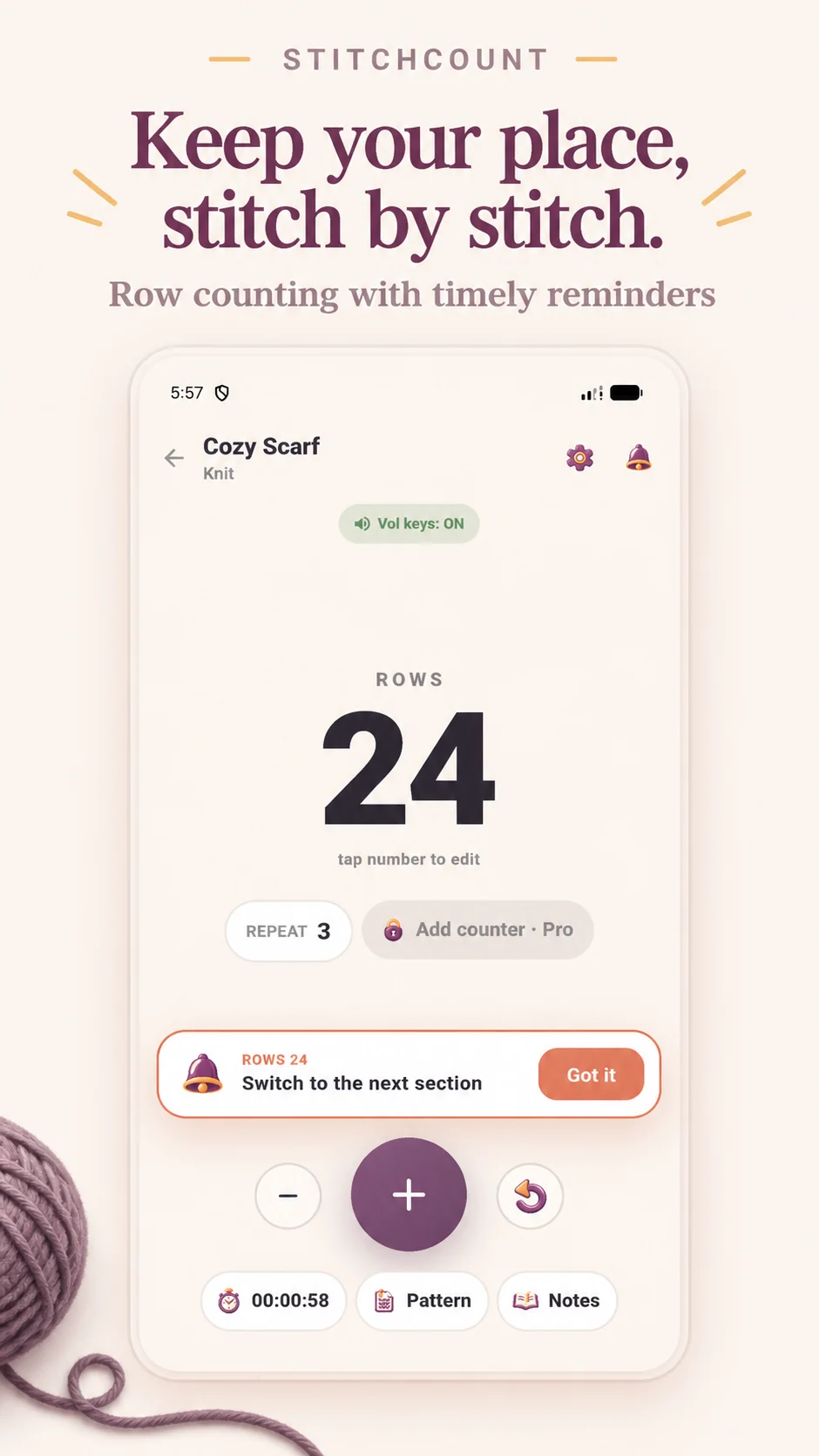
The screenshot is an example project showing a main value of 24 and a repeat value of 3. Its counter settings are not shown; the eight-row arithmetic above illustrates one possible counting convention, not proof of that project’s configuration.
Leave a restart note you can trust
A short pause note can contain the information a number alone leaves out. Suggested fields are: section → total rows completed → whole repeats completed → next repeat row → next overall row → any separate shaping instruction.
For the setup-row example: “After 4 setup rows; total completed 25; 2 whole repeats plus 5 rows; next repeat row 6; next overall row 26.” This is an editorial note template, not a customer testimonial.
Before restarting, compare the note, your actual work and the pattern. If you undo work or notice an accidental tap, correct the affected counts and the note together. When you are unsure which instruction comes next, resolve that uncertainty before adding another row.
For crochet, also check whether your pattern uses US or UK stitch terms. Clear terminology and clear counting conventions prevent different kinds of confusion.
Sources and scope
Pattern terminology: Craft Yarn Council: How to Read a Knitting Pattern and Crochet Abbreviations Master List, checked October 18, 2026.
AppMaven wrote the counting examples and note templates. No complete pattern or source diagram is reproduced. App features were checked against StitchCount’s listing and current product sources; this article is not a hands-on test of a particular pattern.